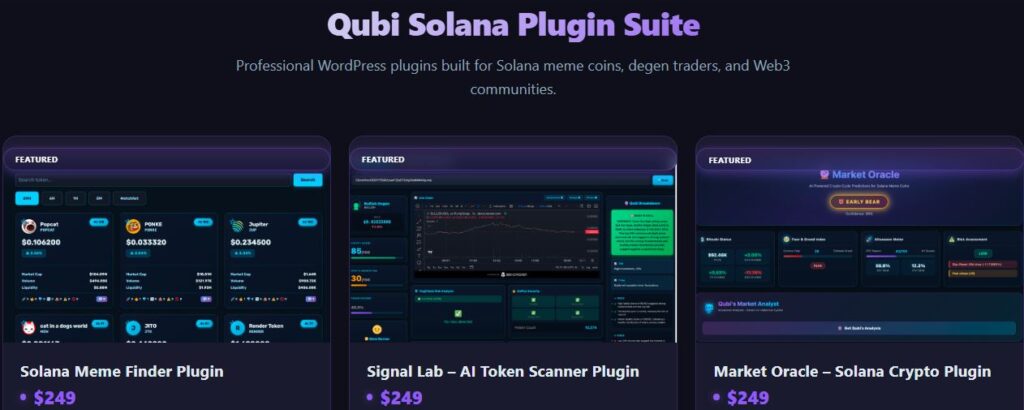
The rise of Solana-powered meme coins and the boom of degen trading culture has changed what Web3 communities need from their websites. A WordPress site that once needed only a blog and a newsletter form now needs live token data, on-chain integrations, wallet-aware content, and community-first features that feel native to crypto users. In this article I explain what professional WordPress plugins designed for Solana meme coins, degen traders, and Web3 communities do, why they matter, and how to approach adding them to a site without turning it into a confusing mess solana wordpress plugins.
Why dedicated Web3 WordPress plugins matter
Traditional WordPress plugins solve common problems: SEO, caching, forms. But Solana meme coins and degen traders require different primitives. They want instant info on launches, token metrics, mint/dex status, rug-check signals, and wallet-aware experiences (think “connect wallet to reveal” rather than “subscribe to see”). A plugin built for Solana integrates with on-chain data sources and popular Solana wallets, understands token metadata formats used by projects, and exposes hooks so site owners can surface real-time token events in blog posts, dashboards, and community pages.
Beyond raw data, the best professional WordPress plugins add trust and moderation layers. Web3 communities can be chaotic; plugins that include admin tools for whitelisting, role gating, and audit logs help communities scale without losing control. Good plugins also prioritize performance: polling Solana RPC endpoints efficiently, caching results, and failing gracefully when an indexer is slow.
Core features to expect from a Solana-focused plugin
A professional plugin should handle several technical responsibilities without requiring the site owner to be a blockchain developer. First, it should fetch and normalize token data: supply, holders, liquidity pool health, recent transfers, and contract-level metadata. Second, wallet integration is essential — seamless support for wallet adapters and popular clients so users can sign messages, log in, and prove holdings. Third, token discovery tools that highlight newly minted tokens or trending meme coins give degen traders the intel they crave. Fourth, safety features: basic contract checks, alerting for suspicious rug signals, and the ability to blacklist malicious tokens or addresses.
Equally important is UX. Widgets that show price tickers, charts, and “new drops” feeds should be easily embeddable into pages and posts. Shortcodes or Gutenberg blocks that display token cards, connect-wallet buttons, or buy links make it possible to compose pages that feel modern and native to the audience. Finally, the plugin should expose developer hooks — REST endpoints, GraphQL, or PHP filters — so experienced teams can extend behavior.
Performance and security considerations
Because these plugins talk to external RPC nodes, or indexer services, caching and rate-limiting are non-negotiable. A professional solution will implement server-side caching with sensible TTLs, exponential backoff when an RPC provider throttles, and optional use of third-party indexers to avoid overloading a single node. From a security standpoint, never store private keys on the WordPress server; all signing flows should happen client-side through wallet providers. Sanitize and validate any on-chain data before rendering it to users to avoid XSS or supply-chain issues from untrusted metadata.
Backups and staging environments are also critical. Test updates in a staging site and use feature flags so you can enable complex features to subsets of users. For communities where token-gated content matters, ensure access-control logic is robust and audited.
Installing and integrating plugins without chaos
Start small: install a plugin’s read-only features first, such as token dashboards or a price ticker, before enabling write flows like token minting or integrated swaps. Use a staging copy of your site and verify how the plugin interacts with your theme and caching layers. If your site already uses aggressive performance plugins or a CDN, make sure their cache rules won’t break wallet connection flows or dynamic token displays.
Consider the plugin’s dependency footprint. Plugins that bundle heavy front-end libraries can slow page loads and conflict with theme scripts. Prefer plugins that offer modular builds — where you only activate the blocks and widgets you need. Finally, document the integration points for your moderators and community managers so they can use the plugin features without breaking governance processes.
Business and community benefits
When implemented correctly, WordPress plugins for Solana meme coins and degen traders can increase engagement, retention, and trust. Real-time token feeds and wallet-aware gating turn casual readers into active participants. Launch pages with integrated minting widgets reduce friction for collectors, while token scanners and alerting features add a layer of safety for newcomers. For projects and communities trying to professionalize their presence, these plugins help bridge the gap between on-chain novelty and a reliable, monetizable web presence.
Choosing a plugin vendor and evaluating support
A plugin is more than code; it’s a product you rely on. Look for vendors that publish clear documentation, maintain test coverage, and respond quickly to security issues. An active changelog and an open channel for bug reports are signs of a responsible vendor. Prefer plugins that let you self-host essential services rather than depending entirely on a vendor-controlled cloud, especially if you value decentralization and continuity.
Conclusion
As Solana meme coins and degen trading culture continue to evolve, the websites that serve those communities must evolve too. Professional WordPress plugins that understand on-chain realities, integrate cleanly with wallets, and prioritize performance and security will be the backbone of many successful Web3 community sites. Start with conservative read-only features, evaluate vendor support and extensibility, and move gradually toward richer integrations. That way you get the benefit of real-time crypto experiences without exposing your site or community to unnecessary risk.